
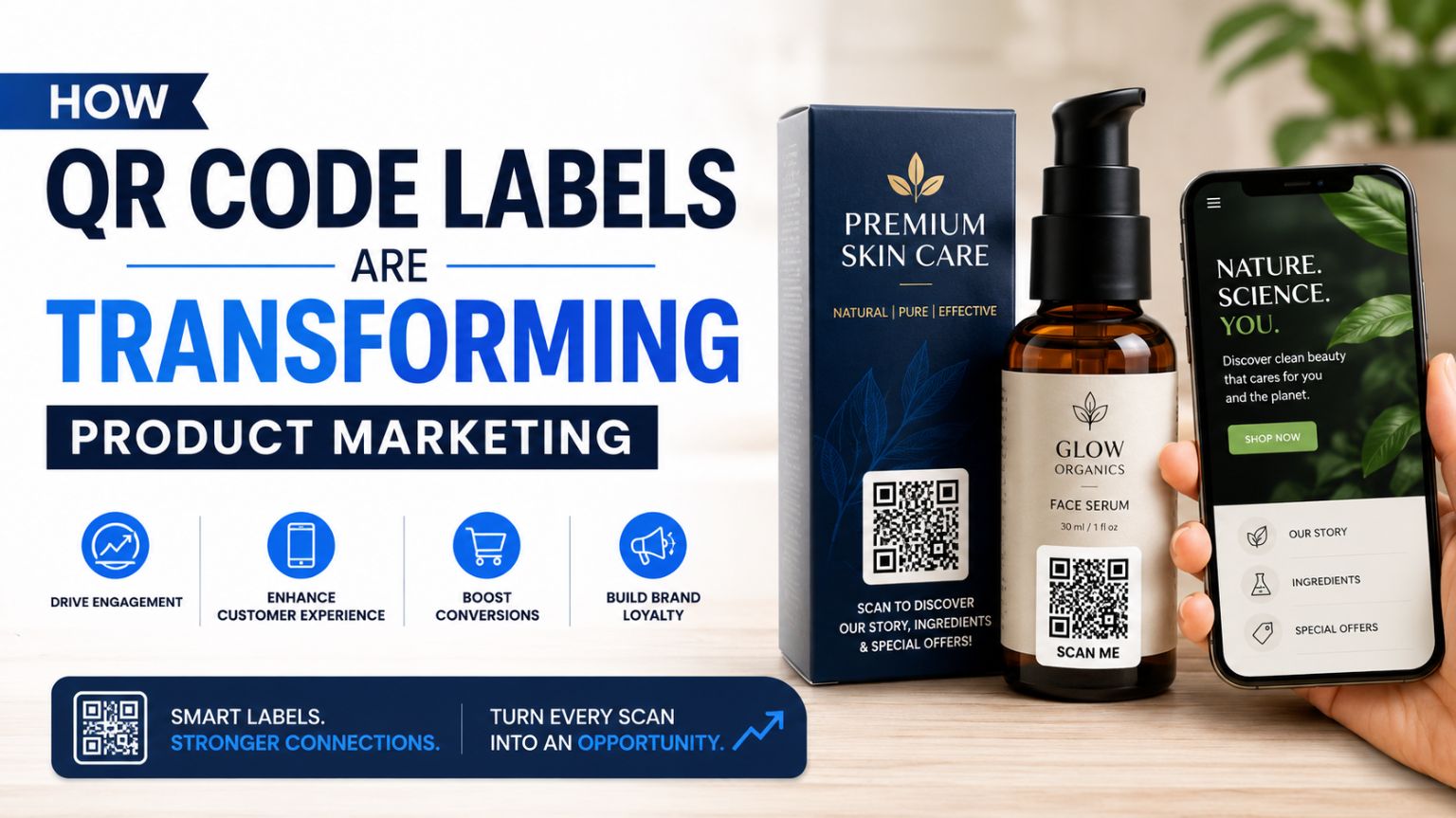
Walk into any supermarket today and you will notice something different about the products on the shelves. Alongside the usual ingredients list and branding, there is a small black-and-white square printed on the packaging. That little square is changing the way businesses connect with customers, manage inventory, tell their brand story, and drive sales, all without redesigning a single package.
QR code labels have moved far beyond their early days of tracking automobile parts in Japan. Today, they are one of the most powerful, low-cost marketing tools available to businesses of every size from global FMCG companies to independent artisan brands.
What Exactly Are QR Code Labels?
A QR code (Quick Response code) is a two-dimensional barcode that stores information in a scannable matrix of black squares. When placed on a product label and scanned by a smartphone camera, it instantly triggers a digital action opening a website, playing a video, displaying product details, or enrolling a customer in a loyalty program.
What began as a simple barcode alternative has transformed into a multilayered gateway for consumer interaction and operational intelligence. By embedding rich data into a two-dimensional matrix, brands gained a direct line of communication with end users, transcending traditional print media.
The Market Numbers Tell the Story
The adoption of QR code labels is not just a trend; it is a market movement with serious financial weight behind it.
The QR Code Labels Market size was estimated at USD 2.56 billion in 2024 and is expected to reach USD 5.06 billion by 2032, growing at a CAGR of 8.86%.
Between 2021 and 2024, QR code scan activity increased by 323%. In the United States, around 100 million smartphone users scanned QR codes in 2025. Meanwhile, the global QR code market is valued at approximately $13 billion and is expected to grow to $33 billion by 2031, reflecting a compound annual growth rate of about 17%.
By 2024, over 35% of new products incorporated dynamic QR codes, enabling real-time updates for enhanced consumer engagement.
These numbers reflect a fundamental shift; consumers are now actively engaging with product packaging, not just reading it.
How QR Code Labels Are Transforming Product Marketing
1. Turning Static Packaging Into an Interactive Experience
Traditional labels have one major limitation: they run out of space. Ingredient lists, compliance text, and branding all compete for the same few square centimetres. A QR code solves this entirely.
QR codes allow consumers to engage with products and learn more about product features and benefits. By simply scanning the code with a smartphone, the user can be redirected to a specific webpage that provides additional product information — highly beneficial for businesses that want to share more details without overcrowding the package.
A vitamin brand can link customers to ingredient research. A furniture company can link to an assembly video. A food brand can share recipes. None of this requires changing the physical label just updating the link.
2. Real Brand Storytelling on Every Product
Modern consumers do not just buy products; they buy values, origins, and stories. QR code labels give brands the space to tell those stories in full.
QR codes are transforming product packaging from static labels into dynamic brand storytelling platforms. They help build brand loyalty, deliver richer product education, and connect with customers in the moments that matter. Content can be updated at any time, engagement can be tracked, and data-driven improvements can be made with ease.
A sustainable clothing brand can show where the fabric was sourced. A coffee company can take customers to the farm where their beans were grown. This kind of transparency builds trust at a depth that no ingredient list ever could.
3. Driving Consumer Engagement Through Interactive Campaigns
Some of the most creative marketing happening today is powered by a simple scan.
Monster Energy used QR codes on its packaging in conjunction with its promotional partnership with Call of Duty gamers, who could scan QR codes on Monster labels to earn tools usable in the game.
Capri Sun enabled consumers to scan a QR code for the opportunity to win a Nintendo Switch 2 prize package. The results highlighted how impactful a seamless and well-positioned scanning experience can be when combined with a trusted, high-performing product.
4. Collecting Valuable Consumer Data and Analytics
Here is where QR code labels give marketers something print advertising never could: real, measurable data.
QR codes offer marketing and branding benefits, including the ability to direct consumers to specific content and to capture data analytics about user engagement with that branded content. This helps businesses analyze consumer behavior and make informed decisions about product features, marketing, and advertising.
QR code software can help you track the promotions consumers are most interested in based on the number of scans, giving your brand marketing team a clearer picture of where or how to optimize strategies for growing product sales.
You can see which products get the most engagement, which regions are scanning most, and which content drives repeat purchases, all from a tiny square on a label.
5. Building Customer Loyalty Programs Directly From the Label
QR codes on product labels turn packaging into an interactive consumer engagement channel that extends the brand experience beyond the point of sale. Brands can use them for product education, loyalty programs, sustainability information, and reordering. LEGO uses this form of loyalty program through QR codes, allowing users to claim reward points by scanning codes printed in set manuals.
Imagine turning every product you sell into a loyalty touchpoint — no app download required, no separate card needed. A single scan enrolls the customer, tracks their purchase, and rewards them instantly.
6. Enhancing Product Transparency and Consumer Trust
Brands such as Nestlé use QR codes to comply with labeling standards and share in-depth ingredient data. Some companies take it further — the protein bar brand The Whole Truth uses QR codes to show customers actual lab test results.
Today’s consumers, especially younger demographics, are deeply skeptical of vague marketing claims. A QR code that links to third-party lab results, certifications, or sourcing documentation speaks louder than any tagline.
7. Fighting Counterfeiting and Verifying Authenticity
QR codes let customers verify a product is genuine with a single scan, fighting counterfeiting without expensive hologram stickers or serial number databases. Louis Vuitton has integrated QR codes into their products, allowing consumers to verify the authenticity of their purchases. For premium and luxury brands, this is not a nice-to-have, it is a brand protection necessity.
8. Streamlining Post-Purchase Experience
The customer journey does not end at the checkout counter. QR code labels bridge the gap between the product and the post-purchase experience.
QR codes provide a simple and efficient way to handle post-purchase processes like warranty registration and customer feedback. Rather than completing and sending a paper form, customers can complete everything instantly with a quick scan. Once collected, this data helps brands streamline support, identify product issues early, and build stronger customer relationships through personalized follow-ups and targeted offers.
Industry-Specific Applications
Retail and FMCG: Dynamic pricing pages, flash sale links, loyalty enrollment, and product education videos.
Food and Beverage: Recipe ideas, sourcing information, allergen details, sustainability credentials, and nutritional deep-dives.
Pharmaceuticals and Healthcare: Dosage instructions, batch tracking, authenticity verification, and regulatory compliance information.
Electronics: Setup guides, product manuals, warranty registration, and software update links.
Fashion and Apparel: Fabric sourcing details, care instructions, styling videos, and brand story content.
Logistics and Supply Chain: Real-time package tracking, delivery confirmation, and chain-of-custody documentation.
Future of QR Code Labels in Marketing
By pairing augmented reality with QR codes, brands can unlock immersive storytelling channels. A scan can launch interactive 3D models, virtual try-ons, or gamified experiences that play out over the real-world package surface.
As of 2025, approximately 92% of businesses are integrating QR code labels into augmented reality features to improve product interaction and consumer engagement.
The next phase of QR code marketing goes beyond links. It will include real-time personalization, AI-driven content delivery, blockchain-verified authenticity, and full integration with IoT ecosystems. The label on your product is becoming a full-spectrum digital touchpoint.
Final Thoughts
The era of the passive product label is over. Today, the label on your product is an opportunity, a chance to tell your story, engage your customer, verify your authenticity, collect real data, and deliver experiences that go far beyond what any printed text can achieve.
QR code labels are not just a technology upgrade; they are a marketing philosophy shift. They move the customer relationship from the point of sale into an ongoing, dynamic conversation that lives as long as the product does.
For any business looking to compete in today’s attention economy, the question is no longer whether to use QR code labels. The question is how soon you can start using them well.
Frequently Asked Questions
Q1. What is the main marketing benefit of using QR code labels on products?
They turn static packaging into an interactive, trackable communication channel, allowing brands to share rich content, collect consumer data, run campaigns, and build loyalty programs, all from a single scan.
Q2. Are QR code labels only suitable for large businesses?
No. QR codes are one of the most cost-effective marketing tools available. Small businesses and startups can implement them with minimal cost using free or low-cost QR code generators, making them accessible at any scale.
Q3. What is the difference between a static and a dynamic QR code label?
A static QR code has a fixed destination that cannot be changed after printing. A dynamic QR code uses a redirect, so the destination can be updated anytime and scan analytics can be tracked, making dynamic codes far more useful for ongoing marketing.
Q4. Can QR code labels help with anti-counterfeiting?
Yes. Each label can carry a unique QR code that links to an authentication page, allowing customers to verify a product’s genuineness with a single scan — more effective and cheaper than holograms for many product categories.
Q5. Will QR code labels become standard across all industries?
The trajectory strongly suggests yes. With regulatory bodies in several countries beginning to mandate digital product information and consumer demand for transparency increasing, QR code labels are on track to become a universal standard on product packaging globally.