
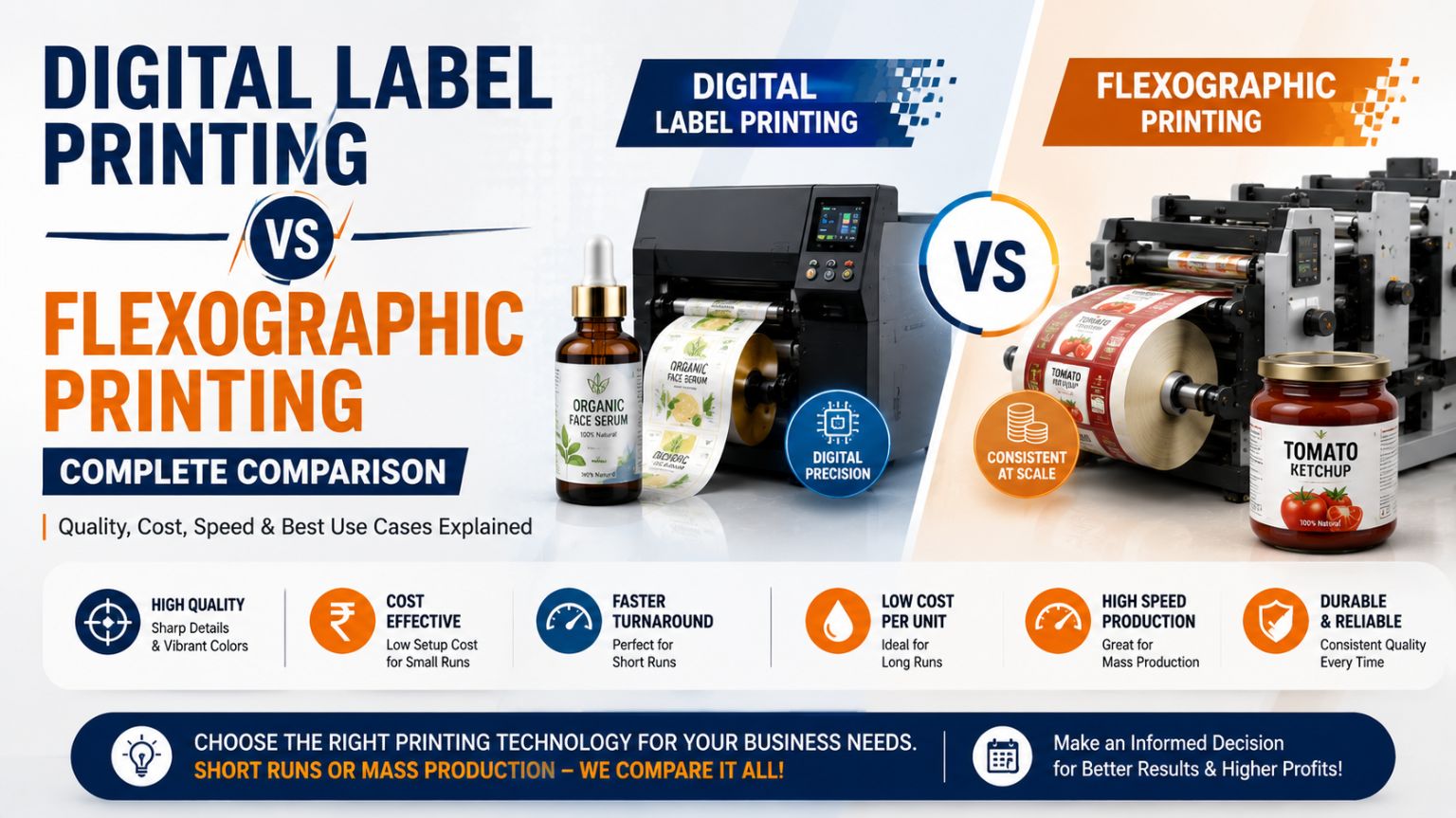
Every product that reaches a store shelf carries a label. That label is the first thing a customer sees, touches, and judges. But before a label ever reaches a bottle, a box, or a bag, a critical decision has already been made: how was it printed?
For businesses investing in product label printing, the choice between digital label printing and flexographic printing is one of the most important production decisions they will face. Get it right and you save money, time, and waste. Get it wrong and you pay for it in every order you place.
What Is Digital Label Printing?
Digital label printing is a modern printing method where labels are produced directly from digital files without the need for physical printing plates. The design is sent from a computer directly to the press, which uses inkjet or laser-based technology with UV or water-based inks to apply the image onto the label material.
Because there are no plates involved, setup time is minimal and every print run starts almost immediately after the file is approved. This makes digital label printing especially suitable for businesses that need fast turnaround, small quantities, or frequent design changes.
What Is Flexographic Printing?
Flexographic printing, often referred to as flexo, is a rotary relief printing process that utilizes flexible plates made from rubber or photopolymer materials. These plates are wrapped around rotating cylinders, coated with fast-drying inks, and pressed against the label substrate as it moves through the press at high speed.
Flexo presses are engineered for continuous, high-speed production. Once the plates are made and the press is set up, it can run for hours producing tens of thousands of labels with consistent quality and color output. The process supports a wide range of substrates including paper, film, foil, synthetic materials, and non-porous surfaces, making it compatible with almost every type of packaging label printing requirement across industries.
How Label Printing Technology Has Evolved
Not long ago, the choice was simple. Flexo was the only viable option for professional-grade labels at any volume. Digital printing existed but was limited in resolution, speed, and substrate compatibility.
That has changed dramatically. The global digital label and packaging printing market is projected to grow from 22 billion dollars to 36.9 billion dollars in the coming years, while the flexographic press market is expected to reach 12.49 billion dollars by 2030, growing steadily at 4 to 5 percent annually. Both are growing, but for different reasons and in different directions.
Digital Label Printing vs Flexographic Printing: Head-to-Head Comparison
1. Setup Process and Lead Time
This is where the two methods differ most sharply.
Digital label printing requires no plate production. Once the artwork file is prepared and approved, printing can begin immediately. Setup waste is typically under 10 meters and changeover between jobs takes as little as 2 to 10 minutes. For businesses with tight deadlines, multiple SKUs, or frequently changing designs, this speed to production is a decisive advantage.
Flexographic printing requires custom plates to be manufactured before a single label is printed. Plate production takes time and adds cost upfront. Setup waste can range from 50 to 200 meters as the press is calibrated for color and registration. Changeovers between jobs can take 20 to 45 minutes depending on the number of print stations and the complexity of the design.
Winner for short runs and fast turnaround: Digital printing | Winner for long established runs: Flexo printing
2. Cost Structure
The cost comparison between these two methods is not straightforward because it depends entirely on print volume.
For short and medium print runs, digital label printing is the more economical choice. Because there are no plate costs, no ink mixing fees, and no press setup charges, the cost per label on a small order is significantly lower than flexo. A business printing 500 or 5,000 labels pays the same setup cost in digital: zero.
For large and very large runs, the economics reverse. Flexographic printing spreads its upfront plate and setup costs across tens of thousands or hundreds of thousands of labels, driving the cost per unit down to levels that digital cannot match at scale. The higher the volume, the greater the flexo cost advantage becomes.
Most converters find that the break-even point between the two methods sits somewhere between 3,000 and 8,000 linear meters, depending on coverage, die complexity, and finishing requirements.
Winner for small runs: Digital printing | Winner for large volume orders: Flexo printing
3. Print Quality and Color Accuracy
Both methods are capable of producing excellent quality labels, but they achieve it differently.
Digital label printing excels at fine detail, intricate artwork, and photographic images. Digital presses commonly hold color variation within a Delta E range of 1 to 2 across a job, which represents very tight consistency.
Flexographic printing delivers vibrant solid colors and consistent output at high speed. A well-dialed flexo press with proper plate and anilox matching produces rich, uniform ink laydown that can feel visually bolder than digital on large solid areas. However, flexo can sometimes struggle with very fine details and high-resolution photographic content, particularly on older press configurations.
Digital presses use CMYK blending to achieve full-color output without needing separate spot color inks, whereas flexo presses traditionally require separate ink systems for each color in the design.
Winner for fine detail and photography: Digital printing | Winner for bold solids and vibrant spot colors: Flexo printing
4. Variable Data and Personalization
This is an area where digital label printing has no competition. Because every label is generated directly from a digital file, any element on the label can be made variable, meaning it can change from one label to the next within the same print run. Serial numbers, batch codes, names, dates, QR codes, and personalized promotional text can all be printed at full production speed without any additional setup or cost.
Flexographic printing cannot produce variable data. Once the plates are made, every label in that run will be identical. Any change to the design requires new plates, new setup, and additional cost.
For businesses in logistics, pharmaceuticals, food safety, promotions, or any field requiring unique label identification, custom label printing with variable data capability is a non-negotiable requirement, and only digital delivers it.
Winner: Digital printing (no contest)
5. Substrate Compatibility
Flexographic printing supports the broadest range of substrates of any label printing method. Paper, film, foil, synthetic materials, BOPP, PET, metallic laminates, and non-porous surfaces are all compatible with flexo ink systems and press configurations. This versatility makes it the preferred choice for industries with strict material requirements such as food packaging, pharmaceutical compliance labeling, and industrial applications.
Digital label printing has expanded its substrate range considerably in recent years, but still lags behind flexo in this area. Certain specialty materials, metallic finishes, and non-standard surfaces can present challenges for digital presses, though the gap is narrowing with each generation of press technology.
Winner: Flexo printing
6. Minimum Order Quantities
One of the practical advantages of digital label printing for growing businesses and startups is the complete absence of minimum order requirements. Whether you need 50 labels or 50,000, the setup process and cost remain the same. This is particularly valuable for new brands launching products, businesses running limited edition packaging, or companies managing multiple product variations.
Flexographic printing is not economical for small quantities. The plate production and setup costs must be recovered, which means minimum order quantities are typically enforced by printers to ensure the job is commercially viable. Ordering fewer labels than the break-even threshold means paying a higher per-unit cost than digital would have charged.
Winner: Digital printing
7. Durability and Environmental Resistance
Flexographic printing produces labels with stronger overall durability. Flexo labels typically hold up better against outdoor exposure, UV light, moisture, chemicals, and abrasion. The inks used in flexo production tend to offer greater long-term resistance, making flexo the preferred choice for products that spend time outdoors, in cold storage, or in demanding industrial environments.
Digital label printing inks, particularly inkjet-based formulations, can be more susceptible to fading under prolonged sunlight exposure compared to flexo inks. However, with UV curing technology, modern digital labels have significantly improved in durability and the gap with flexo continues to narrow.
Winner: Flexo printing for outdoor and industrial applications
8. Finishing and Embellishment Options
Flexographic printing presses frequently feature inline finishing capabilities, including die-cutting, laminating, embossing, varnishing, foil stamping, and tactile coatings. These finishing options can be applied in a single pass through the press, reducing production time and handling. Innovations in anilox technology allow for gloss and matte contrasts, textured finishes, and advanced embellishment techniques that give shelf presence and premium appeal to packaging label printing output.
Digital label printing is making progress in inline finishing but still has fewer options than flexo in this area. Some embellishment techniques that require plates or specialized coating systems are not yet fully available in digital workflows, though hybrid presses are beginning to bridge this gap.
Winner: Flexo printing for premium finishing
Commercial Label Printing: Which Industries Use Which Method?
Understanding which businesses and sectors naturally gravitate toward each method helps clarify the practical application of each technology.
Commercial label printing operations that rely heavily on flexographic printing include food and beverage manufacturers producing high volumes of consistent labels, household goods and cleaning product brands, pharmaceutical companies requiring durable and compliant labeling on large runs, logistics providers printing millions of shipping and tracking labels, and cosmetics brands needing specialty substrates and premium finishes at scale.
Commercial label printing operations where digital printing excels include craft beverage producers and artisan food brands launching new products, e-commerce businesses with multiple product SKUs or frequent design updates, pharmaceutical companies requiring serialized and variable data labels for compliance, promotional and seasonal campaigns requiring short runs with personalized content, and startups needing professional-quality labels without committing to large minimum quantities.
The Hybrid Approach: Best of Both Worlds
Increasingly, the industry is moving toward a hybrid model where digital and flexo capabilities are combined on the same press. A hybrid press can use flexo units for consistent background colors and spot coating applications, then switch to digital engines for variable data, photographic imagery, or personalized content.
This approach eliminates the need to choose one method at the expense of the other. Brands managing complex product lines with both high-volume staple labels and short-run seasonal or promotional variants benefit most from hybrid production capabilities.
For businesses that do not yet have access to hybrid printing, working with a commercial label printing partner who offers both digital and flexo services allows the right method to be selected job by job rather than committing to one approach permanently.
Final Thoughts
Neither digital label printing nor flexographic printing is universally superior. They are different tools built for different jobs, and the most successful businesses understand when to use each one. Custom label printing decisions should be driven by data: your order volume, your budget, your timeline, your substrate requirements, and the complexity of your design. When those factors point clearly in one direction, the choice becomes straightforward.
As label printing technology continues to advance, the gap between digital and flexo is narrowing in quality while widening in application. Digital is becoming more capable at scale. Flexo is becoming more flexible with digital integration. The future of packaging label printing belongs to businesses that understand both methods well enough to leverage whichever one serves the job at hand.
Frequently Asked Questions
Q1. Which printing method is better for small businesses?
For small businesses, digital label printing is almost always the better starting point. There are no plate costs, no minimum order quantities, and fast turnaround times. A startup can print 100 labels of professional quality without the financial commitment that flexo requires.
Q2. Can digital label printing match flexo quality for premium packaging?
For most applications, yes. Modern digital presses produce excellent resolution and color accuracy. However, for labels requiring specialty finishes such as embossing, foil stamping, or certain metallic effects, flexo still holds an advantage in available finishing options.
Q3. What is variable data printing and why does it matter?
Variable data printing means each label in a run can contain unique information such as serial numbers, QR codes, or personalized text. Only digital label printing supports this. It is critical for pharmaceutical traceability, logistics tracking, and personalized promotional campaigns.
Q4. What is a hybrid press and should my business consider one?
A hybrid press combines flexo and digital printing units on the same machine, allowing brands to use each method where it performs best within a single production run. For businesses with complex or varied label requirements, hybrid printing offers the most flexible and cost-effective solution.
Q5. Which method is more sustainable?
Both have made progress on sustainability. Digital label printing produces less waste on short runs because there are no plate materials and minimal setup waste. Flexographic printing has moved toward water-based and UV-curable inks, reducing chemical use and improving food safety compliance. The most sustainable choice depends on the specific run length and materials involved.