
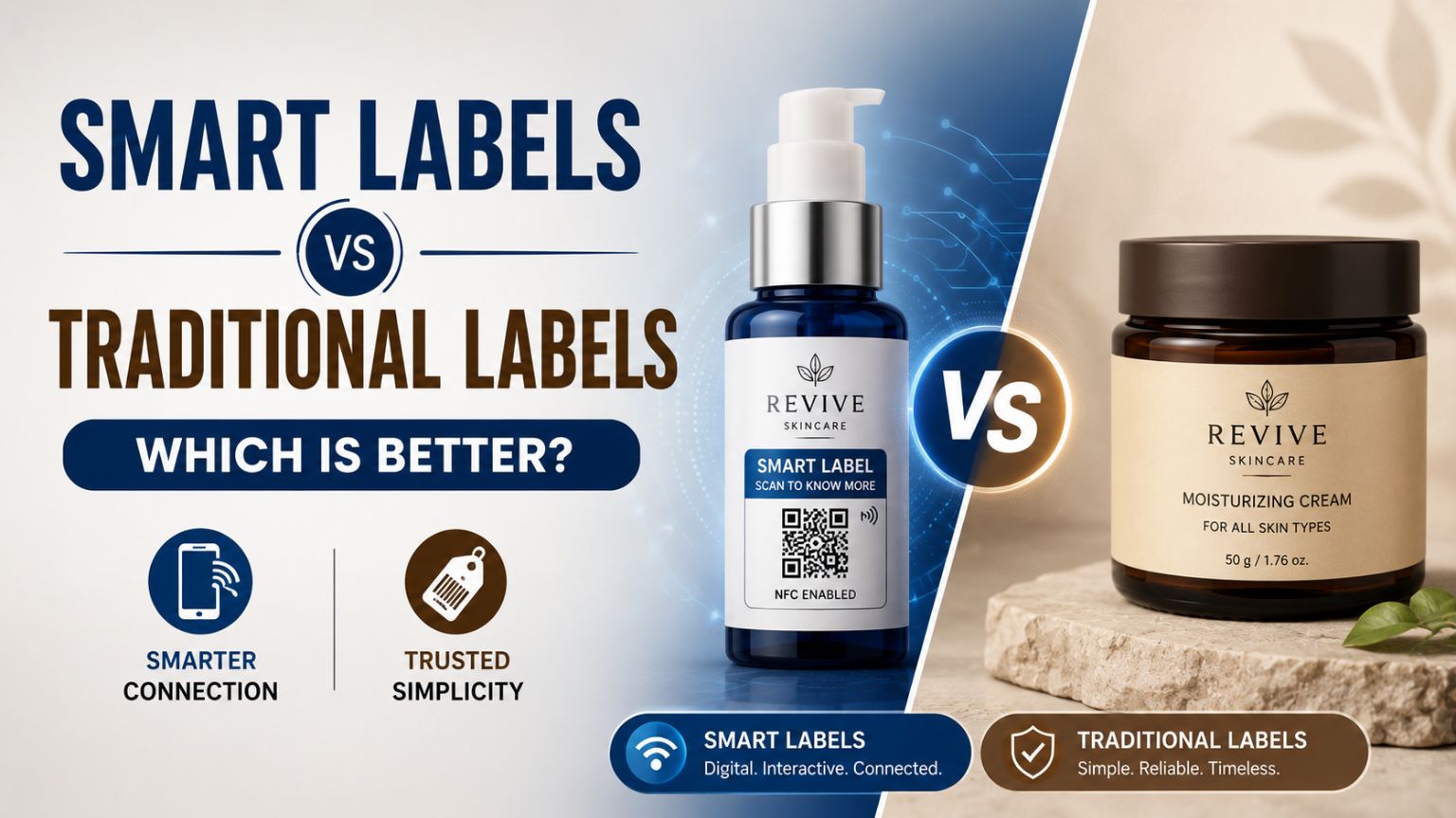
In today’s fast-moving business world, how you label your products matters more than most people realize. Labels are not just stickers; they carry your brand, product information, compliance data, and now, even real-time tracking capabilities. With the rise of smart labels, businesses are rethinking everything they know about packaging and identification. But does that mean traditional labels are completely outdated? Or do they still hold their ground?
What Are Traditional Labels?
Traditional labels are the standard printed stickers or tags that have been used for decades across industries. They display fixed, static information: product name, price, ingredients, barcode, manufacturer details, and expiry dates. They are printed using offset, flexographic, or screen printing methods and are widely used across retail, food and beverage, logistics, and manufacturing sectors.
They are simple, affordable, and universally understood. No smartphone or scanner is needed to read them, just your eyes.
Common types of traditional labels include:
Paper labels, pressure-sensitive adhesive labels, foil labels, polyester labels, and shrink-sleeve labels. These serve industries ranging from food packaging to industrial equipment tagging.
What Are Smart Labels?
Smart labels are solutions that elevate traditional labeling by incorporating digital technologies. They go beyond providing surface-level data to open up a world of information to both customers and businesses. Instead of only showing static information like product names and ingredients, they carry dynamic and interactive content.
Smart labels incorporate technologies such as QR codes, RFID tags, or NFC chips to provide additional information and functionalities beyond traditional labelling. These labels support real-time tracking, product authentication, and interactive customer engagement, improving both supply chain efficiency and customer experience.
How Label Technology Has Evolved
The journey from a printed paper tag to an NFC-enabled chip is a story of technological necessity. Businesses needed more than just identification; they needed visibility, security, and customer engagement. Label technology has evolved significantly, with smart labels equipped with RFID and NFC being able to store and transmit detailed data about a product’s journey from production to the consumer’s hands — something particularly crucial in food and pharmaceuticals, where traceability is paramount for safety and compliance.
The Smart Label Market is estimated to expand to USD 75.91 billion by 2035, growing at a robust CAGR of 15.29% between 2025 and 2035, starting from a valuation of USD 15.87 billion in 2024. This growth alone tells you that label technology is no longer a niche — it is a mainstream business priority.
Smart Labels vs Traditional Labels: A Head-to-Head Comparison
1. Information Capacity
Traditional labels are limited by physical space. Once the label is printed, the information on it is fixed forever. You cannot update it, expand it, or link it to additional content.
Smart labels go beyond static printed text, integrating components such as microchips, antennas, or sensors to store, transmit, and update data. A smart label can provide real-time information about a product, including its origin, journey through the supply chain, and even its current condition, unlike conventional labels, which only display fixed details like price and ingredients.
Winner: Smart Labels
2. Cost
Traditional labels offer a clear cost advantage for many businesses. Materials such as paper and polyester are affordable, easy to produce, and do not require specialized technology or infrastructure. This makes them a practical choice for small businesses and organizations working with limited budgets.
In comparison, smart labels that utilize technologies like RFID or NFC typically involve higher production expenses. Beyond the label cost itself, businesses may need to invest in additional equipment and systems, including scanners, readers, and data management platforms. For companies operating in highly competitive markets or industries with tight profit margins, these added costs can make smart label adoption a more challenging investment.
Winner: Traditional Labels
3. Inventory & Supply Chain Management
Smart labels with RFID or NFC technology make it easy to track products in real time. Businesses can monitor inventory, reduce losses, and streamline operations with just a quick scan, no more manual counts or outdated records, as everything is updated automatically, making the entire supply chain more efficient.
Traditional labels rely on manual barcode scanning or visual checks, which are slower and more error-prone at scale.
Winner: Smart Labels
4. Consumer Engagement
Where traditional labels convey simple product information, smart labels help consumers connect with the brand, authenticate it, and even provide a purchasing incentive. Customers can scan a QR code to watch a product tutorial, verify authenticity, or access loyalty rewards instantly.
Traditional labels offer no such interactivity. They communicate, but they do not engage.
Winner: Smart Labels
5. Ease of Use & Universality
Traditional labels need no technology to read. They work everywhere in markets, warehouses, rural areas, and offline environments. Smart labels require compatible devices, internet connectivity, and sometimes dedicated apps or readers. For businesses operating in low-tech environments, traditional labels remain the most practical choice.
Winner: Traditional Labels
6. Anti-Counterfeiting & Security
Counterfeiting is a huge issue in many industries, and smart packaging technology can help tackle that challenge directly. RFID and NFC chips are difficult to clone, and each label can carry a unique digital fingerprint. Traditional labels, even with holograms, are far easier to counterfeit.
Winner: Smart Labels
7. Environmental Impact
Both types have environmental considerations. Traditional paper labels are biodegradable but generate significant print waste. Smart labels contain electronic components that are harder to recycle. Printed RFID labels are now being used in food and beverage tracking, offering a scalable solution for industries that require high-volume, low-cost labeling, with printed electronics making smart labels more sustainable over time.
Industries That Benefit Most from Smart Labeling Solutions
Key industries that benefit from labeling solutions powered by smart technology include retail (inventory management and customer engagement), healthcare (accurate medication tracking and asset management), logistics and supply chain (error reduction and enhanced efficiency), manufacturing (component and quality tracking), food and beverage (temperature-sensitive product monitoring), and pharmaceuticals (drug authentication and storage monitoring).
When Should You Still Use Traditional Labels?
Not every business needs to invest in smart label infrastructure. Traditional labels remain the better choice when: Your budget is limited and volume is low. Your products do not require real-time tracking. You operate in regions with limited digital infrastructure. Your customers are not tech-savvy or do not use smartphones. You sell simple, low-risk consumer goods that need no authentication. A small bakery, a local clothing boutique, or a handicraft seller does not need NFC-enabled tags on every product. For them, a well-designed, high-quality traditional label is perfectly adequate.
The Role of Digital Labels in Bridging the Gap
Between the two extremes lies an interesting middle ground of digital labels. Digital label printing is a modern method that uses digital printing technology instead of traditional methods, making it more cost-effective, faster, and suitable for short runs without requiring printing plates or other setup costs. Digital label printing allows for the inclusion of variable data such as barcodes, numbering, and personalized information without slowing down the print process, particularly useful for applications in logistics, retail, and personalized marketing.
Digital labels offer flexibility in design, faster turnaround, and the option to incorporate smart features like QR codes without full RFID investment. For growing businesses, this is often the most practical first step toward smarter labeling.
Smart Labels: Challenges to Consider
While the benefits are compelling, smart labels are not without their challenges:
Higher upfront cost: RFID and NFC infrastructure require significant investment. Data privacy: Smart labels collect consumer behavior data, which must be handled responsibly. Lack of universal standards: Not all smart label systems are compatible across platforms. Technologies behind smart labels, like embedded sensors and connectivity, require more investments, making some companies hesitant to adopt them fully.
Which Is Better: Smart Labels or Traditional Labels?
The honest answer is that it depends on your business size, industry, budget, and goals. If you run a large-scale operation in retail, pharma, logistics, or food supply chains, smart labels offer unmatched efficiency, traceability, and consumer engagement. The investment pays off quickly in labor savings, error reduction, and supply chain visibility. If you run a small business, operate in a cost-sensitive market, or sell products that require no tracking, traditional labels are reliable, affordable, and perfectly functional. The smartest approach for most growing businesses? Start with digital labels for quality and flexibility, then integrate smart features like QR codes as your operations scale.
Final Thoughts
The debate between smart labels and traditional labels is not about which is universally better — it is about which is right for your specific situation. As labeling technologies continue to advance, businesses that evaluate both approaches carefully can make more informed decisions for their supply chain operations, brand messaging, and customer engagement. Whether you are exploring label technology for the first time or looking to upgrade an existing system, choosing the right label is a strategic decision not just a printing one.
Frequently Asked Questions
Q1. What is the main difference between smart labels and traditional labels?
Traditional labels display fixed printed information, while smart labels incorporate digital technologies like RFID, NFC, or QR codes to store, transmit, and update data in real time.
Q2. Are smart labels more expensive than traditional labels?
Yes, smart labels typically cost more due to embedded technology and the infrastructure needed to read and manage them. However, costs have been decreasing as adoption grows.
Q3. Can small businesses benefit from smart labels?
Small businesses can start with QR code-based labels, which are affordable and easy to implement. Full RFID systems are better suited for larger-scale operations.
Q4. What industries use smart labels the most?
Retail, healthcare, logistics, pharmaceuticals, food and beverage, and manufacturing are the leading adopters of smart labeling solutions.
Q5. Are traditional labels becoming obsolete?
Not entirely. Traditional labels remain widely used for their simplicity, low cost, and universal readability, especially for small businesses and low-complexity products.